Solutions — Cost Optimization
Optimize your cloud with confidence.
Oscar identifies every optimization opportunity, maps dependencies and ownership, and shows exactly what can be changed safely, all within the first 24 hours.
What the assessment delivers
Six domains. One scan. One report.
A Cloud Optimization Assessment analyzes your full environment across six dimensions simultaneously. Every finding carries a confidence score, ownership attribution, and a remediation horizon. Here is what the report looks like.
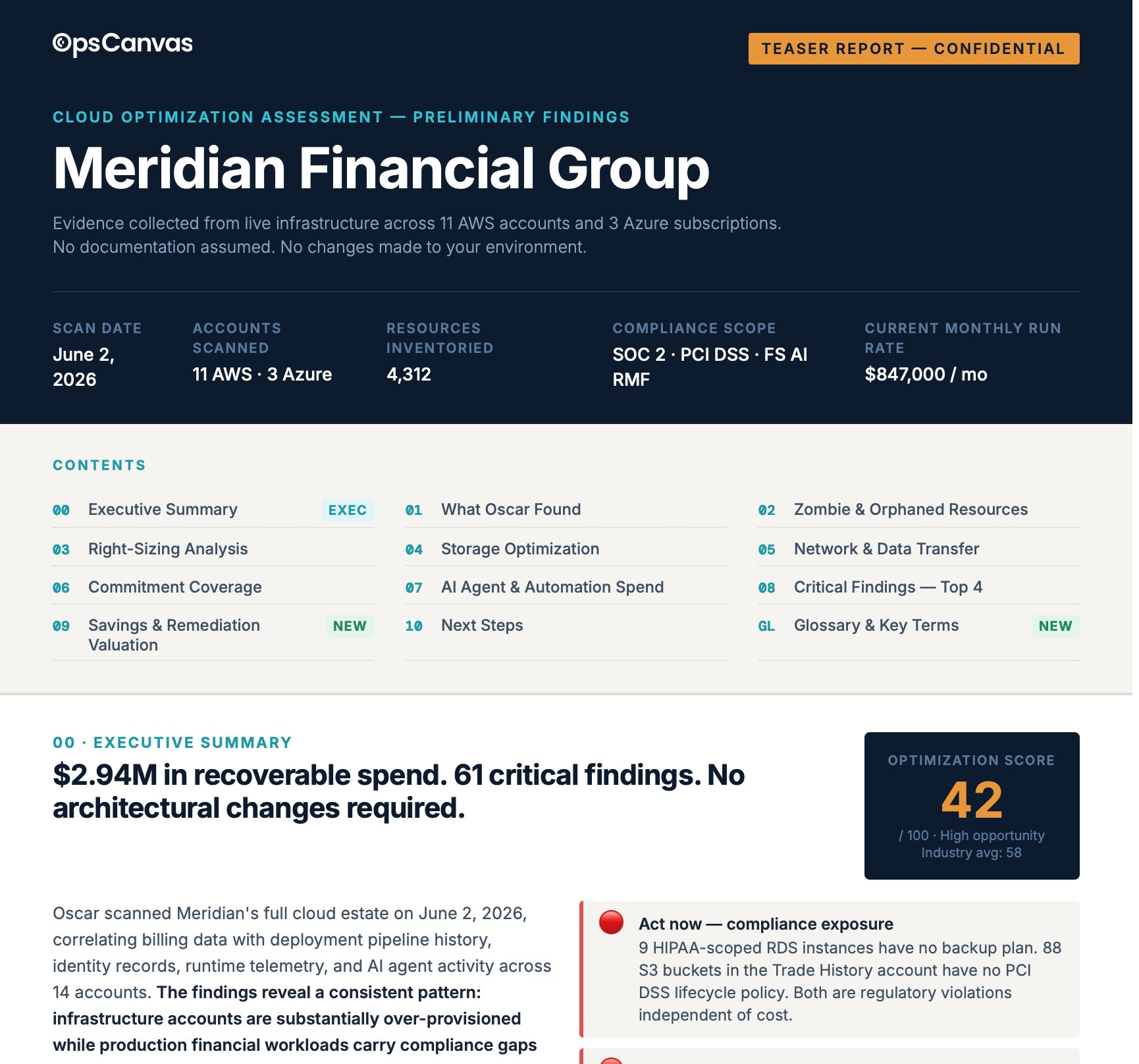
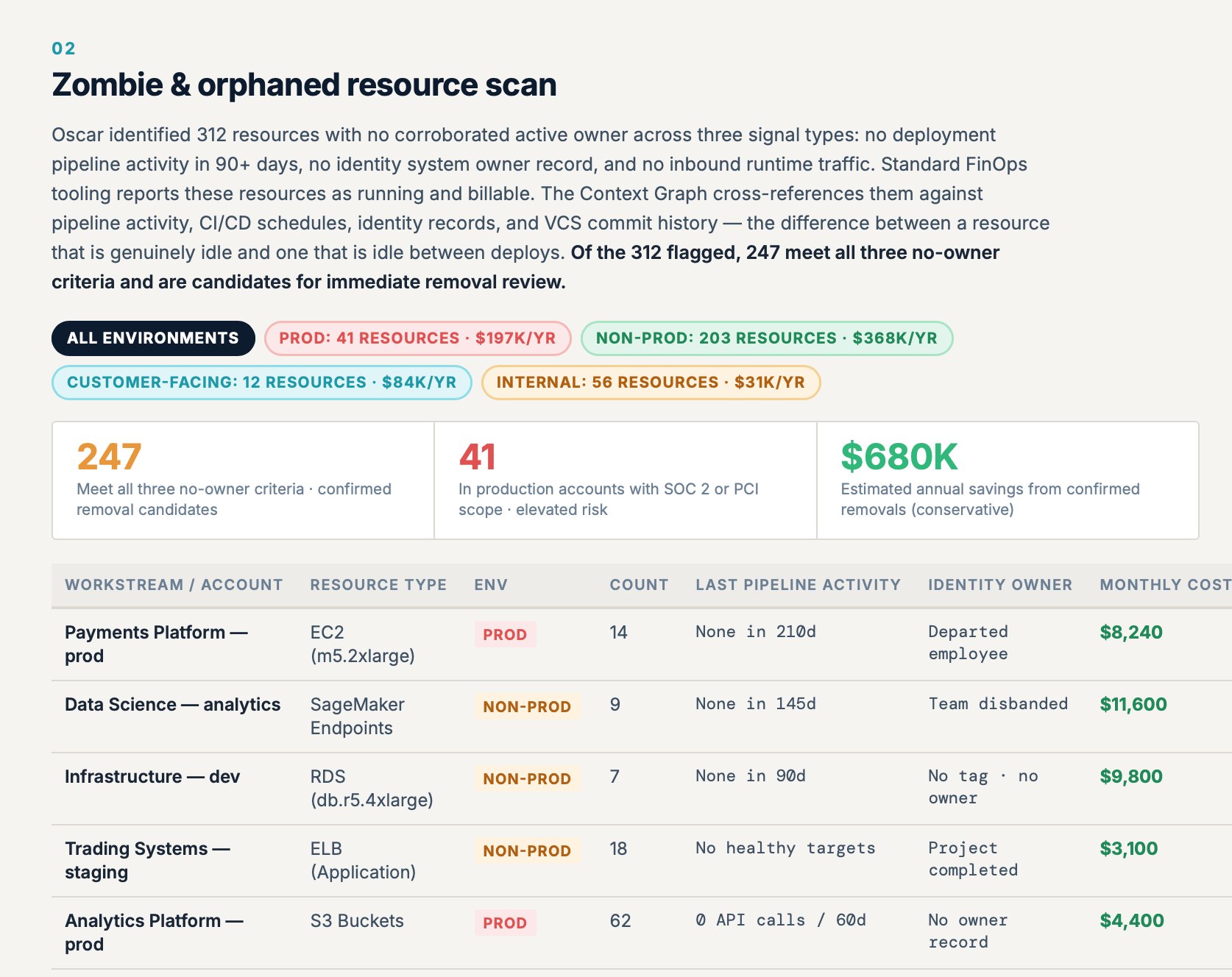
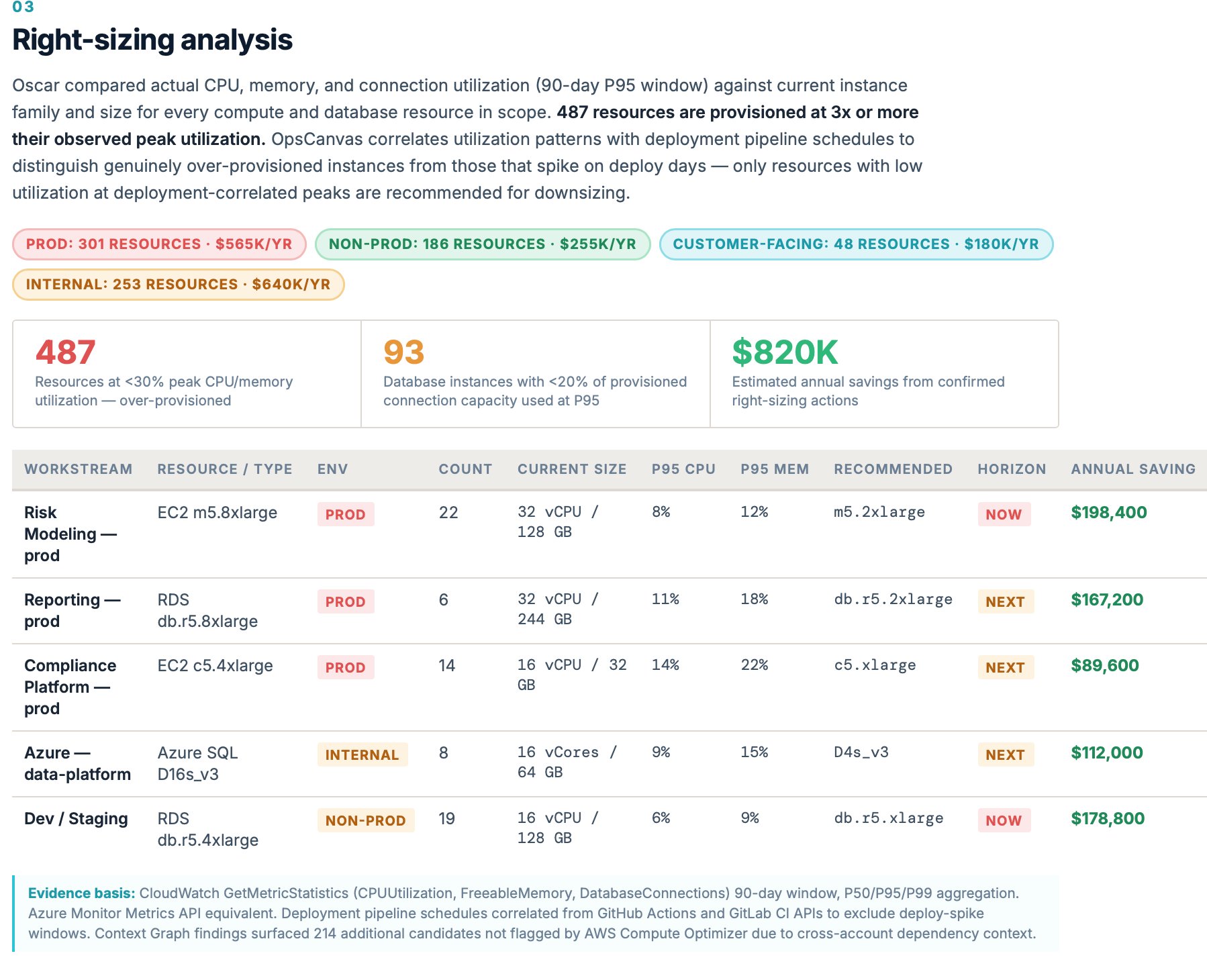
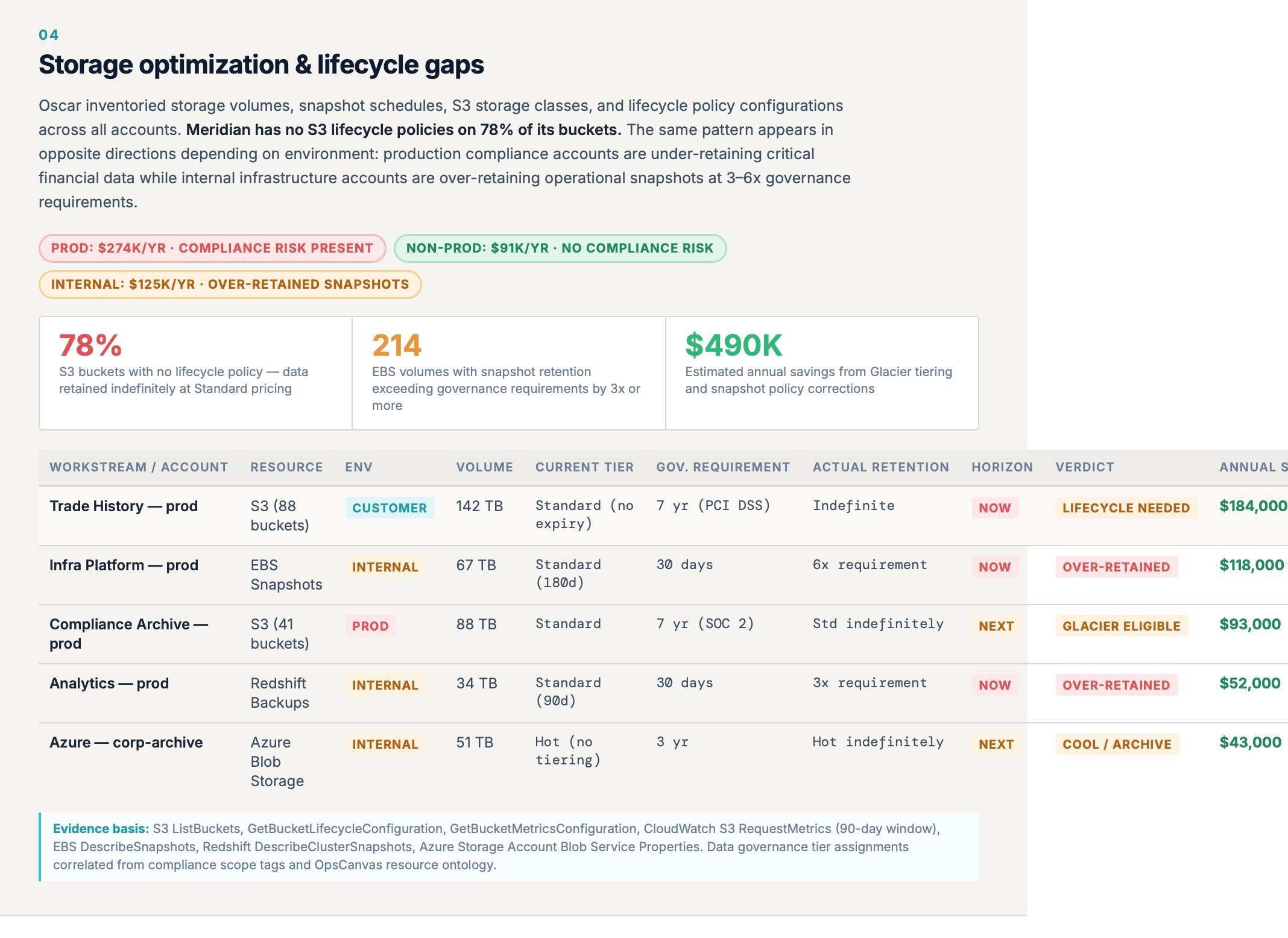
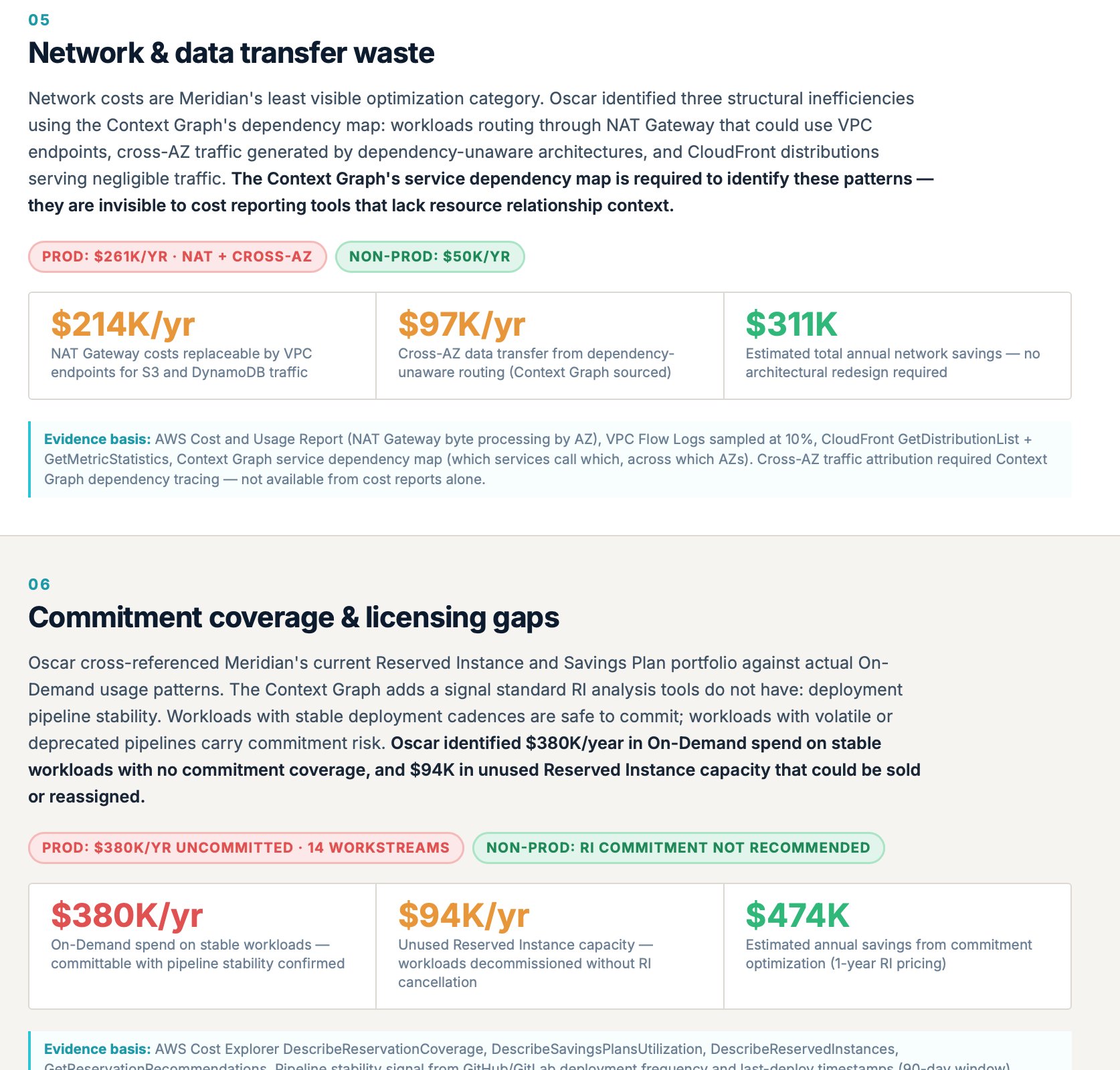
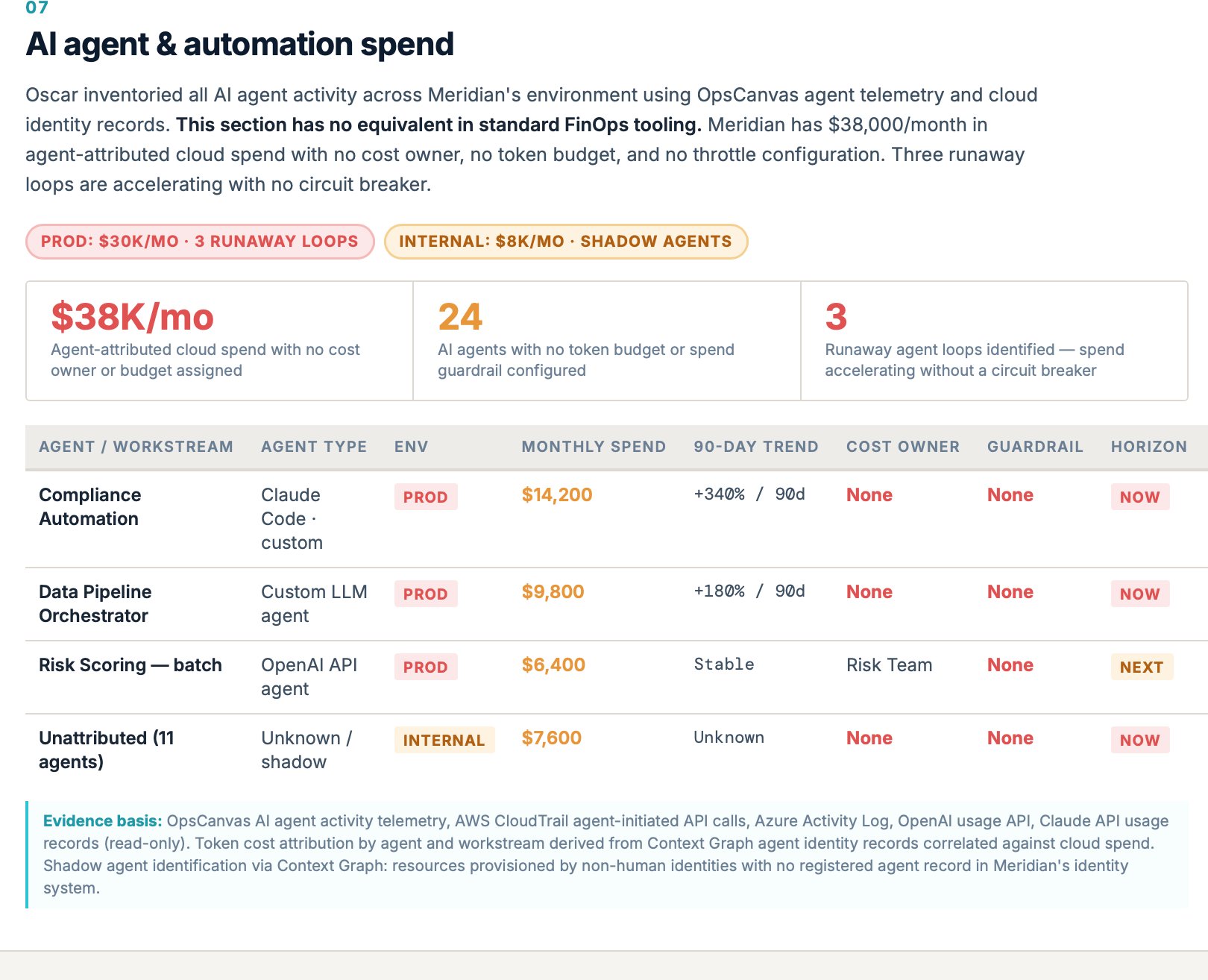
Six Optimization Domains
What standard FinOps tooling misses in every domain
A FinOps tool sees your bill. The Context Graph sees your environment. In every domain, that difference changes what is actionable.
A list teams don't trust. Can't tell a quarterly batch job from dead weight.
Three-signal scoring. 247 of 312 confirmed high confidence.
Utilization numbers with no dependency context. Teams don't act.
Dependency map verifies safety first. Surfaces 214 candidates Compute Optimizer missed.
GB and tier costs. No governance or compliance context.
Compliance scope cross-referenced against actual lifecycle config. Cost and regulatory gaps in one finding.
NAT charges appear in the bill. Source is invisible without dependency data.
Service dependency map traces which calls generate cross-AZ traffic and unnecessary NAT routing.
RI tools can't tell stable workloads from volatile ones. Risky commitments.
Pipeline stability verified per workstream before any commitment recommendation.
No FinOps tool covers agent identity. Token costs and runaway loops are invisible.
Per-agent cost attribution, runaway loop detection, and shadow agent identification.
The Real Blocker
Optimization stalls because teams can't act confidently. The Context Graph fixes that.
Every finding comes with the evidence needed to move. Who owns this? What depends on it? What breaks if it changes? Answered before you act.
Ownership attributed, not guessed
Every finding traces to a team or individual via pipelines, CI/CD history, and identity records, not tags alone.
Blast radius before you act
The dependency map shows what will be affected by every proposed change before anything touches production.
Confidence scores on every finding
High-confidence removals are separated from items needing ownership verification. Work the right things first.
Idle vs. purposefully quiet
DR standbys and quarterly batch jobs look idle. The Context Graph carries months of history to tell the difference.
Governance memory built in
Team preferences like 'maintain 10% headroom' are captured once in the Context Graph and applied consistently to every recommendation.
Shared context across your team
Oscar Pro lets your whole team work remediations together. One engineer's investigation benefits everyone. No repeated discovery.
How It Works
Less than one hour of your team's time. Results in 24 hours.
No multi-week onboarding. No consultants to brief. No data export to prepare. Oscar connects with read-only credentials and does the work.
Connect your environment
Read-only credentials, your existing role assumptions. No changes made. No credentials stored centrally. Works across AWS, Azure, and GCP simultaneously. Your team's involvement at this stage: under one hour.
Under 1 hour of engineering timeOscar builds the Context Graph
Oscar correlates cloud account data against deployment pipelines, CI/CD history, identity records, VCS commit history, runtime telemetry, and AI agent logs. Six domains analyzed simultaneously. No team time required.
Fully automatedReport delivered in 24 hours
Resource-level findings with confidence scores, ownership attribution, environment classification, and remediation horizons for every item. Not a list of opportunities. An evidence-backed plan your team can act on immediately.
Full findings in 24 hoursWhy OpsCanvas
How we compare to the alternatives.
Every FinOps team considers the same options. Here is where each falls short.
What You Receive
Not a list. An evidence-backed plan.
Every item in the assessment report is backed by traceable evidence. Here is what every engagement delivers.
How It Grows
Assessment to monitoring to workflow
Three stages on the same graph. Each builds on the last. The gap that repeats earns the next step.
Assessment
Six-domain scan of your full cloud environment. Confidence-scored findings with ownership attribution, savings estimates, and a 90-day remediation roadmap delivered within 24 hours.
Monitoring
Continuous detection across all six domains as your environment changes. New waste surfaces as it appears. Agent spend anomalies alert before they compound. Choose quarterly, monthly, or continuous cadence.
Workflow
AI-governed orchestration for large remediation programs. Agents handle evidence gathering, dependency verification, and action preparation. Humans approve every material decision. Full audit trail.
Oscar Pro: tackle remediation as a team
After the assessment surfaces the opportunities, Oscar Pro lets your engineering team work through them together. Shared context means each engineer understands ownership, dependencies, and blast radius without repeating discovery individually. Tasks are distributed, approvals are tracked, and the Context Graph updates as items are resolved. Learn more about Oscar Pro.
Get Started
Find out what you are spending on that you do not need to be.
Less than one hour of your team's time to connect. Full findings across all six optimization domains in 24 hours. Evidence your team can act on, not a list to argue about.